You've meant to record your parents' or grandparents' stories several times. And each time something got in the way — the technology, the question of where to begin, the worry that it might feel awkward. This guide is built for exactly that moment. It's for people who've never recorded anything and don't want to spend hours reading first.
Why starting today is worth it
Anyone who's ever listened back to a recording of a family member who has passed knows: a voice is more than its content. It carries an accent, a hesitation, a laugh — things no photo and no transcript captures. In the research on biographical self-reflection (Hubert Klingenberger and others), storytelling is described as "integrative work": a person organises themselves by telling. Whoever listens becomes part of that organising.
The most common sentence in our inbox is: "I wish I had started sooner." That's not melodrama, it describes a very concrete gap. Before illness, a move, or simply routine make it harder, a quiet afternoon is enough to begin — that's all you need.
What blyven handles — and what you do
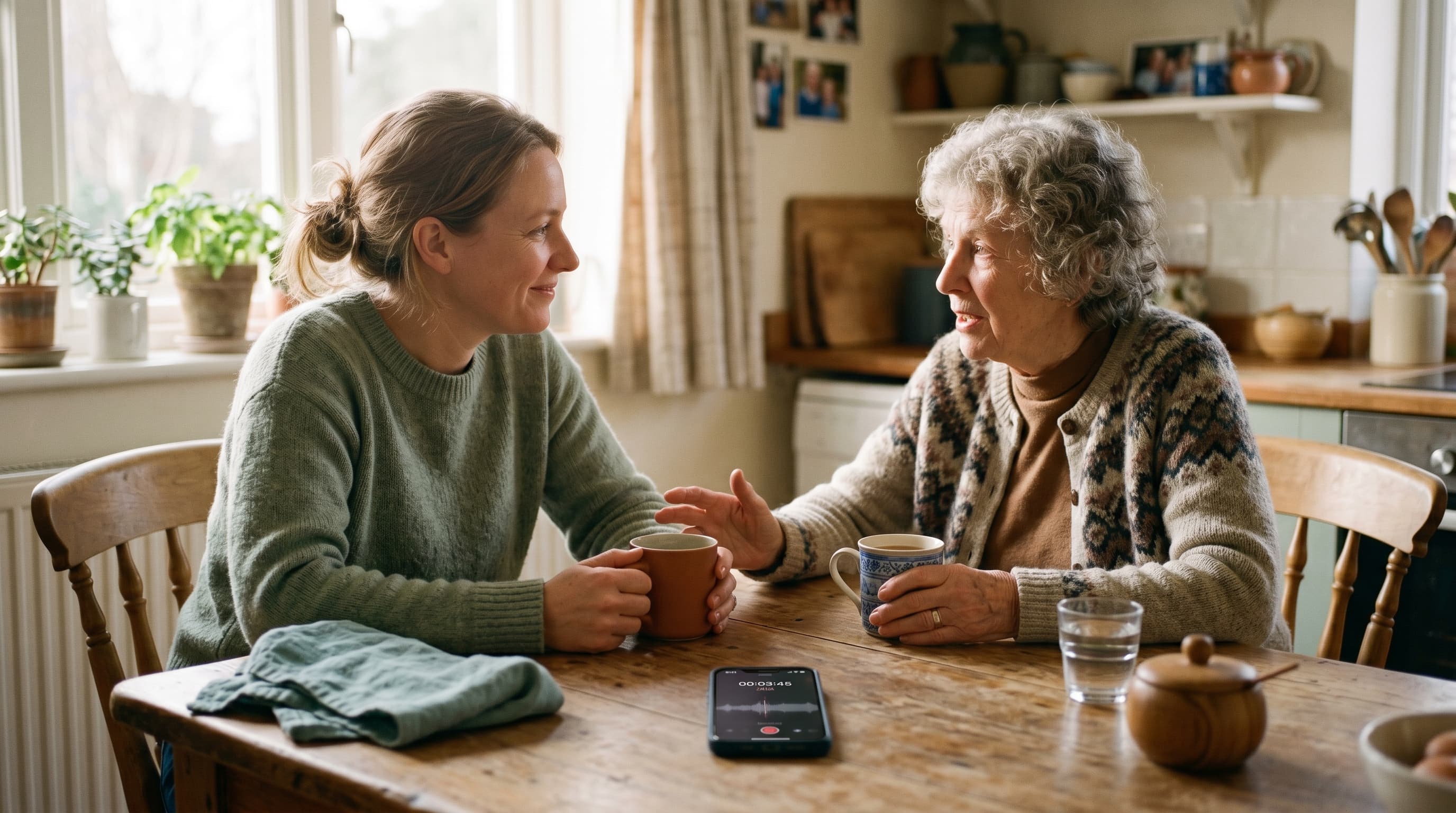
You don't need a studio or a professional microphone. blyven records in high audio quality with one tap, encrypted automatically and stored in the EU. What you bring: the environment. A room with soft surfaces (curtains, sofa, rug — they absorb echo), two chairs side by side rather than facing, a glass of water within reach. And a little unpressured time.
You also don't have to assemble the questions yourself. blyven includes over 1,500 guided questions organised into themed Storybooks — childhood, family, work, love, life themes, faith, home. Pick a topic and blyven suggests the next question, or use free recording when the story is already there. Both work — most families mix.
Step by step: making the recording
Step one: say what you intend. A short, direct sentence works best — "I'd like to record what you tell me. Not for the public, just for us as a family." Ask explicitly for consent. That clarity dissolves the tension that almost always rises when a phone is suddenly "there." In qualitative interview research this is called informed consent — it's not only the ethical baseline, it also makes the conversation better.
Step two: hit record, put the phone one or two meters away, microphone not facing a wall. Then talk briefly about what you're doing — the weather, the day of the week, a stray memory. This warm-up matters: the first two minutes almost always sound stiff, after which speech loosens. You don't have to keep those minutes later.
Step three: open with a concrete, sensory question. For every Storybook, blyven proposes open-ended starters — "Tell me about the house you grew up in" rather than "How was your childhood?" If the story stalls, ask about details: smell, sound, what was on the table. The Storybooks are not a fixed programme — you can switch to free recording any time the conversation finds its own path.
What happens automatically after the recording
As soon as the recording stops, blyven syncs it encrypted to the EU cloud. It can't be accidentally deleted, it doesn't live only on the phone that could break tomorrow. You can download it any time as an audio file or as a full ZIP export — the recordings are yours, portable at any moment. blyven suggests a title and date based on timestamp and chosen Storybook.
blyven transcribes (on paid plans) the spoken content into searchable text — years later you'll find a specific anecdote in seconds. To share with siblings or children, create a family circle: you decide who can listen and respond. No one outside the circle has access. Sharing a full recording is usually too much; a well-chosen excerpt lands — blyven lets you mark individual passages for this.
Common obstacles — and how to get around them
"My parents don't want to be recorded." Don't make the recording the focal point. Start with a photo album or an old letter — blyven lets you attach a photo directly to a recording — and let the phone capture quietly in the background. After ten minutes it's forgotten. Important: still ask beforehand. Secret recording isn't just legally problematic, it poisons the trust you're actually building.
"The recording sounds boring when I listen back." That's the most common and honest worry — and usually unfounded. You're hearing it close up, and you know the person too well. Play it again in two or five years, or give it to a family member who wasn't there. You'll find: what felt unremarkable in the moment is exactly what counts later — the cadence, a small laugh, an offhand remark.
Start with a Storybook — or record freely
blyven suggests a Storybook based on the relationship. You can also record without a prompt — both are equally valid.
Start your first recordingRead next
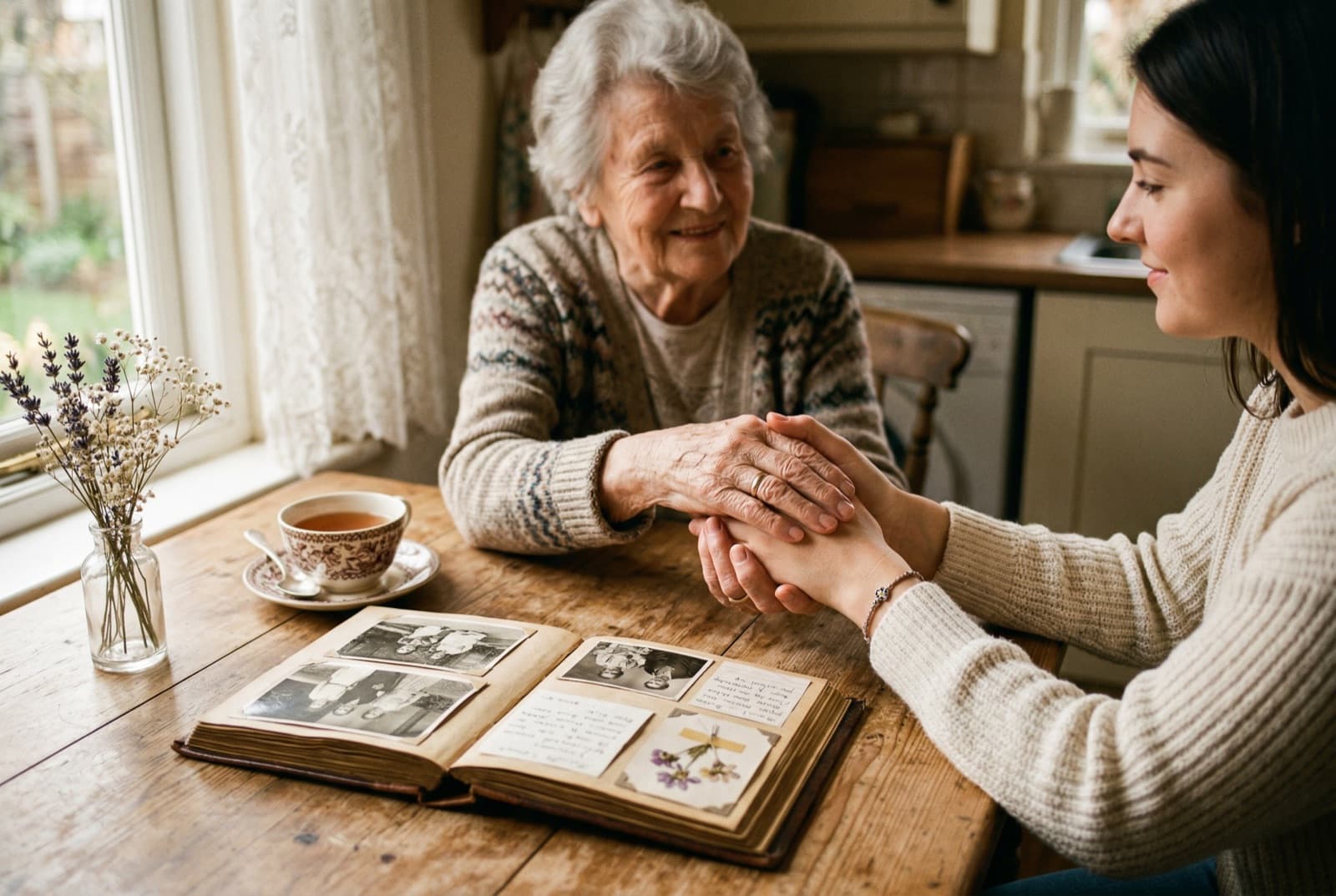
Questions I Would Ask My Grandparents
30 meaningful questions to preserve your grandparents' stories, wisdom, and memories — before it's too late.
Read more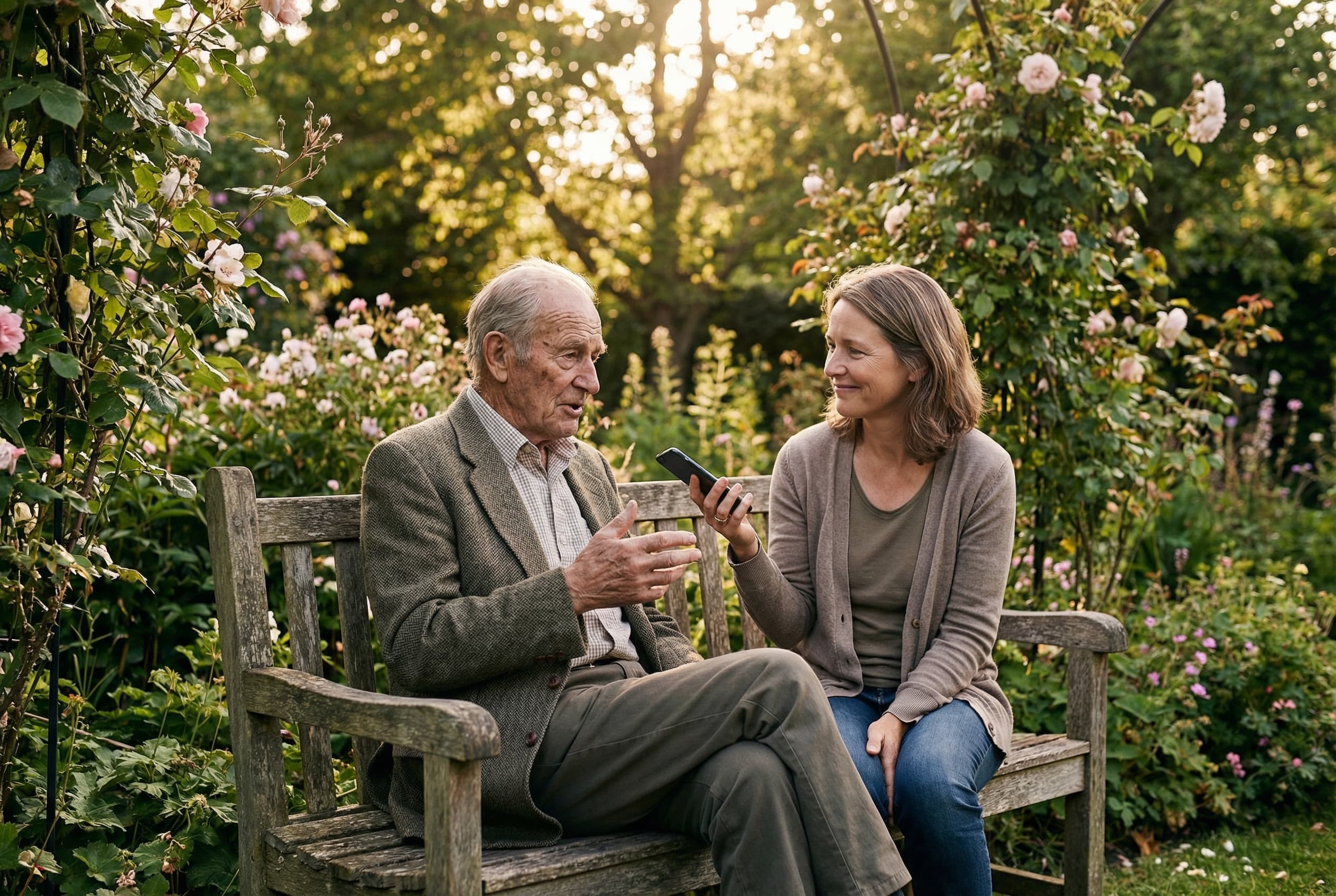
Biography Work: Understanding the Past to Shape the Future
What professionals call "biography work" can transform family conversations too — and it starts with a single question.
Read more
In the Beginning, It Was Just an Idea
How blyven grew out of personal experiences — and why memories are so precious.
Read more