May is ALS Awareness Month — a month that brings attention to a disease many people only learn about when they or someone close to them is affected. Every year in May, organizations around the world raise awareness about ALS, support patients and their families, and advocate for research, care, and greater understanding. This article is not medical advice and does not replace consultation with a doctor. It aims to inform — and to remind us how precious time, words, and voice can be.
What is ALS?
ALS stands for amyotrophic lateral sclerosis. It is a progressive neurological disease that affects the motor neurons — the nerve cells in the brain and spinal cord that control voluntary muscle movement and functions like speaking, swallowing, and breathing. When these nerve cells are damaged, they can no longer send signals to the muscles. The result: muscles weaken, movement becomes harder, and over time daily life changes deeply.
ALS is a rare but serious disease of the nervous system. It mainly affects muscle control. Early symptoms can vary widely: muscle weakness, stumbling, problems with hands or legs, muscle twitches, slurred speech, or difficulty swallowing. Over time, ALS can affect the ability to walk, speak, eat, and breathe independently.
According to the German Society for Muscle Diseases (DGM), about 1 to 2 in 100,000 people are diagnosed with ALS each year in Germany. Worldwide incidence is similar, at roughly 1 to 2.6 cases per 100,000 people — globally about 80,000 to 200,000 new diagnoses per year.
ALS usually begins between the ages of 50 and 70; men are slightly more often affected than women. ALS is not the same as multiple sclerosis — they are different diseases.
Importantly: ALS does not progress the same way for everyone. Some symptoms develop slowly, others faster. Some people first notice problems with walking or gripping; others first notice changes in speech or swallowing.
Why ALS Awareness Month matters
ALS does not only change the body. ALS changes families, partnerships, roles, daily life, and plans for the future.
A diagnosis can shift many things: conversations meant for later. Memories meant to be recorded someday. Words long meant to be spoken — for which the right moment never came.
That is exactly why awareness matters. Not only so more people understand what ALS means medically, but also so we become more sensitive to what this disease means emotionally — for those affected, for children, for partners, family members, and friends.
ALS Awareness Month is a reminder: time is not a given. Neither are words.
ALS and voice: when communication becomes precious
With ALS, speech can change. Pronunciation can become less clear, speaking slower or more effortful, and at some point hardly possible. Breathing, voice, and swallowing can also be affected. The German Society for Muscle Diseases (DGM) describes that very different changes in speech can occur with ALS, and that communication needs support as the disease progresses.
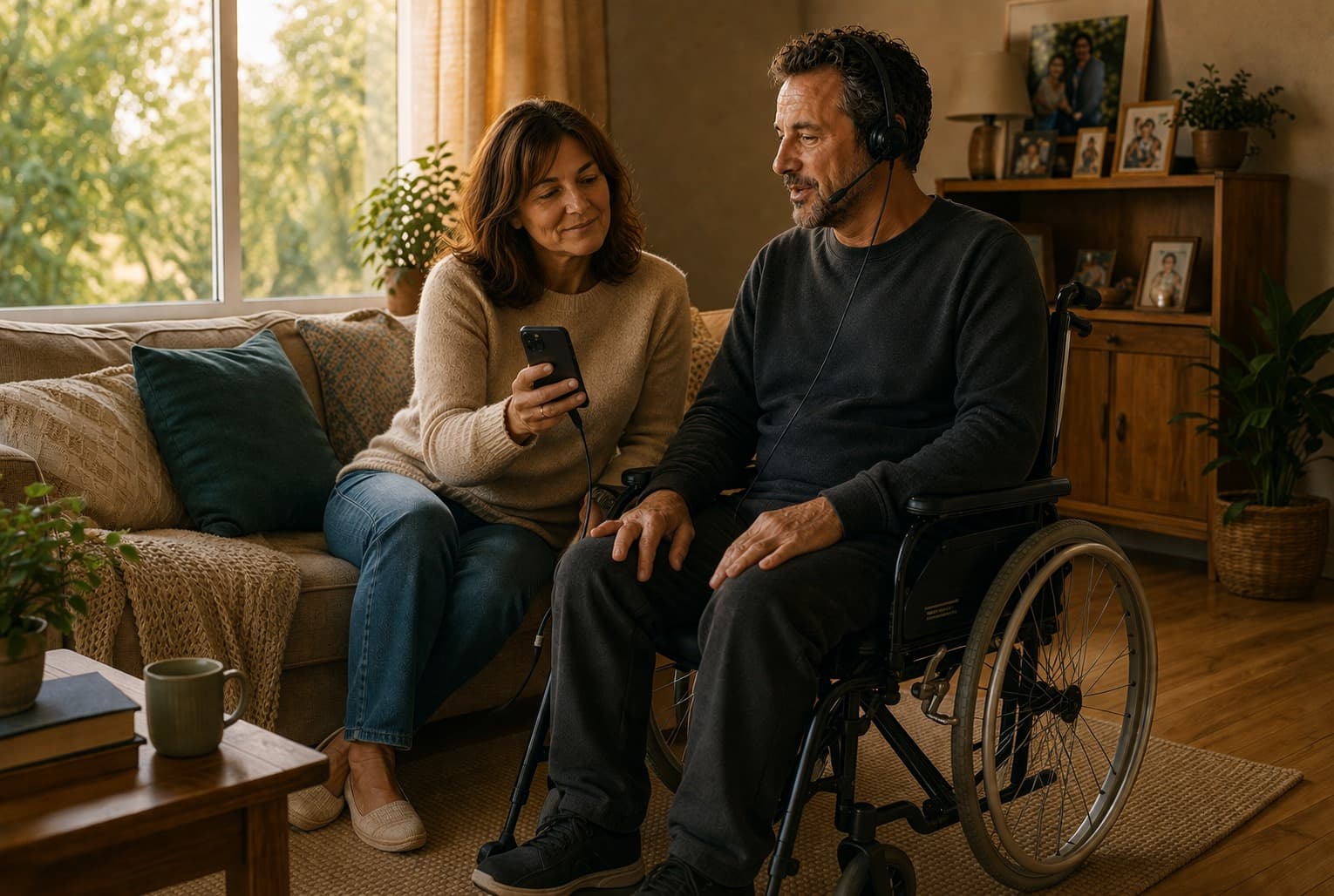
For many patients, this makes assistive tools important: speech-generating devices, augmentative and alternative communication, eye-gaze systems, or other technical solutions. Eye-gaze systems can let people with ALS use eye movement to select letters, words, or sentences on a screen, which the device then speaks aloud.
Voice banking or message banking can also play an important role for some people: speech samples or personal messages are recorded early so that later a synthetic voice or saved messages can be used. Such steps should ideally be discussed with specialists like speech-language pathologists or the ALS care team.
And yet, alongside medical communication, there is another layer:
the personal voice.
Not just the voice that conveys information.
The voice that creates closeness.
The voice that says:
"I love you."
"I'm proud of you."
"I want to tell you this."
"This is who I was."
"This is what I wish for your life."
Why early memory preservation can matter
Many people wait. Not out of indifference. But because the topic is hard.
They wait for the right moment.
For more calm.
For a good day.
For the strength to begin.
But with progressive diseases, the right moment can quietly pass.
Preserving memories does not mean giving up. It means keeping something. For yourself. For the people who want to listen. For your own children, who will have questions later. For a partner, friend, or family member who one day wants to hear a familiar voice again. Later, when memory fades.
It is not about perfect recordings. Not about long life stories. Not about pressure.
It can begin with a single question:
What do you want your children to know about you, one day?
How blyven can help
blyven is a digital place where people can capture voice messages and memories — in their own voice, at their own pace, for the people who matter to them. blyven is a sanctuary for family voice memories and a space where voices, stories, and recollections can be preserved across generations.
With blyven, people can speak freely or follow guided questions. blyven offers more than 1,500 questions across 8 languages, providing a framework for personal biography work — without pressure, without specialists, but with one idea: every story matters.
For families touched by ALS, this can be especially valuable:
to capture memories early. To record personal messages for children or family. To gather thoughts when writing is hard. To preserve words while they can still be spoken. To share recordings with chosen circle members.
blyven does not replace medical voice banking, speech therapy, or technical communication aids. But blyven can be a personal, protected space to preserve what daily life might otherwise lose: stories, thoughts, wishes, love — spoken in your own voice.
Depending on the plan, blyven offers voice recordings, circle sharing, AI transcription, cloud sync, and export options.
10 questions that can be a beginning
- 1.What was one of the best days of your life?
- 2.Which childhood memory do you want to preserve?
- 3.What do you want to pass on to your children one day?
- 4.What are you proud of in your life?
- 5.Which people shaped you most?
- 6.What did you learn through hard times?
- 7.Which story do you love telling again and again?
- 8.What advice would you give your younger self?
- 9.What should your loved ones never forget?
- 10.What do you want to say today, while you can say it?
For family members: how to begin gently
A conversation about memories, voice, and the future can be emotional. So it's important not to push the person. What can help:
Start short. - Five minutes can be enough.
Don't seek the perfect moment. - A quiet afternoon will do.
Don't judge. - Pauses, soft words, or tears are part of it.
Leave questions open. - Not every question has to be answered today.
Let the person living with ALS stay in control. - They decide what is recorded and who can hear it.
Don't make it only about the disease. - ALS is part of life — but not the whole story.
It's not only about what is lost
With ALS, we often talk about loss: strength, mobility, speech, independence.
But that view is not complete. Because there is also what stays:
Love. Humor. Memories.
Closeness. Glances. Stories.
Voice.
Maybe that's exactly why memories matter so much. Not because they take away the pain. But because they create connection.
For today. For later.
For the people who remain.
Say it while you can say it
ALS Awareness Month is a moment to look more closely. Not only at the disease, but at the people behind it.
At their stories. Their families.
Their voices. Their words.
When ALS arrives in a family, much changes. But what was said, what was recorded, what was held with love — that can stay.
Maybe it begins with a single question.
With a single recording.
With a sentence that has been unspoken for too long.
Hold on to what matters to you.
While you can say it.
With blyven you can preserve memories in your own voice — for yourself and for the people who matter to you.
Start today with a single question.
Take three minutes today and answer one question. When your child, your partner, or someone close to you hears the recording someday in the future, it will not be the audio quality that matters. Hearing your voice will be what matters most. Remembering you. Learning more about your life, your thoughts, your wishes. They will be grateful that you had the courage to begin today.
Discount and donation
We can't change the trajectory of the disease, but we can make it easier for families to keep the voice — the laughter, the bedtime story, the answers to a child's question — before the moment passes. This May we're putting blyven within reach for every family and turning every paid subscription into a contribution to ALS support. Because ALS matters to us personally, throughout May 2026 every plan is half price with the code BLYVEN-ALS-50 (one-time use). On top of that, we donate 10 % of the revenue from every paid May subscription to Deutsche Gesellschaft für Muskelkranke (DGM) e.V. — so every paid subscription actively contributes. Enter the code BLYVEN-ALS-50 at sign-up or upgrade and get 50 % off (one-time use, valid all of May 2026, monthly and annual plans). More about the campaign →
Frequently asked questions
- What is ALS?
- ALS stands for amyotrophic lateral sclerosis. It is a progressive neurological disease that affects the motor neurons in the brain and spinal cord. These nerve cells control voluntary muscle movement and functions like speaking, swallowing, and breathing.
- What symptoms can occur with ALS?
- Possible symptoms include muscle weakness, muscle twitches, problems with walking or gripping, slurred speech, swallowing difficulties, and over time also breathing problems. Symptoms and the course of the disease can vary widely from person to person.
- Can ALS change the voice?
- Yes. ALS can affect the muscles needed for speaking, breathing, and swallowing. Speech can become less clear, more effortful, or eventually barely possible. That's why it can make sense to engage early with communication, assistive tools, and personal voice recordings.
- Is there a cure for ALS?
- There is currently no cure for ALS. Medical treatments, therapies, assistive devices, and multidisciplinary care can help manage symptoms, support quality of life, and preserve communication for as long as possible.
- Why can it make sense to record memories early?
- ALS can affect the ability to speak as it progresses. Personal voice messages, stories, and notes can be very valuable later for family members — especially when recorded in the real voice of someone they love.
- Does blyven replace medical voice banking?
- No. blyven does not replace medical voice banking, speech therapy, or communication aids. But blyven can be a personal space to record memories, thoughts, and messages as voice notes and to share them with chosen members of your circle.
Hold on to what matters to you
With blyven you can preserve memories in your own voice — for yourself and the people who matter to you. With code BLYVEN-ALS-50 every paid plan is half price all of May 2026 (one-time use).
Start with blyvenContinue reading

Parkinson's hypophonia: how to preserve the voice
Hypophonia is the softening voice of Parkinson's. Why to start recording now — and how to capture a parent's voice at home with almost no setup.
Read more
World Voice Day: preserve the voice of your parents
Your parents' voice is irreplaceable. Why World Voice Day is the right moment to capture it — today, at home, with just a quiet conversation.
Read more
Biography Work: Understanding the Past to Shape the Future
What professionals call "biography work" can transform family conversations too — and it starts with a single question.
Read more